

Release Notes
1.0.0
Added
- Initial Release.
- Cynet plugin fetches Threat IoCs (SHA256, Domain, IP Address, and URLs) from Cynet Alerts, and also supports Remediation Action on a File (SHA256).
This document explains how to configure the Cynet v1.0.0 plugin for the Threat Exchange module of the Netskope Cloud Exchange platform. Cynet plugin fetches Threat IOCs (SHA256, Domain, IP Address and URLs) from Cynet Alerts, and also supports Remediation Action on a File (SHA256).
Prerequisites
To complete this configuration, you need:
- A Netskope Tenant (or multiple, for example, production and development/test instances)
- A Netskope Cloud Exchange tenant with the Tenant plugin and Threat Exchange plugin already configured.
- Connectivity to a Cynet instance. Collect your Cynet Base URL, Client ID, Username, and Password information. These are needed to configure the plugin.
Cynet Plugin Supports
Cynet plugin fetches Threat IoCs (SHA256, Domain, IP Address and URLs) from Cynet Alerts, and also supports Remediation Action on a File (SHA256).
| Fetched Indicator Types | Actions Supported |
|---|---|
| URL(Domains, IP Address), SHA256 | Remediation: – Delete File – Unquarantine – Verify File – Kill Process |
Mappings
Pull Mapping
| Cloud Exchange Fields | Cynet Fields |
|---|---|
| Value | SHA256 : 1 AlertDomain : 1 AlertIp : 2 AlertUrl : 3 |
| Type | SHA256 : 0 URL : 1 URL : 2 URL : 3 |
| firstSeen | FirstSeenUtc |
| lastSeen | LastSeenUtc |
| comments | IncidentDescription |
| extendedInformation | AlertUrl |
Severity Mapping
| Cloud Exchange Severity | Cynet Severity |
|---|---|
| Unknown | 1 |
| Low | 2 |
| Medium | 3 |
| High | 4 |
| Critical | 5 |
| Unknown | 99 |
API Details
List of APIs used
| API Endpoint | Method | Use case |
|---|---|---|
| /api/account_token | POST | To generate the auth token. |
| /api/alerts/bulk | GET | To pull alerts from Cynet |
| /api/file/remediation/delete | POST | To perform Delete File Remediation Action |
| /api/file/remediation/path/quarantine | POST | To perform Quarantine File Remediation Action |
| /api/file/remediation/unquarantine | POST | To perform Unquarantine File Remediation Action |
| /api/file/remediation/verify | POST | To perform Verify File Remediation Action |
| api/file/remediation/kill | POST | To perform Kill Process Remediation Action. |
Get Access Token
Endpoint: /api/account_token
Method: POST
Data
| Key | Value |
|---|---|
| user_name | \<User Name\> |
| password | \<Password\> |
Headers
| Key | Value |
|---|---|
| User-Agent | netskope-ce-5.0.0-cte-cynet-v1.0.0 |
| Accept | application/json |
| Content-Type | application/json |
Sample Response
{
  "access_token": "string"
}
Pull alerts
Endpoint: /api/alerts/bulk
Method: GET
Headers
| Key | Value |
|---|---|
| User-Agent | netskope-ce-5.0.0-cte-cynet-v1.0.0 |
| Accept | application/json |
| Content-Type | application/json |
Params
| Key | Value |
|---|---|
| LastSeen | 2019-08-24T14:15:22Z |
| Limit | 100 |
| Offset | 1 |
| access_token | \<Access Token\> |
Sample Response
{
  "SyncTimeUtc": "2019-08-24T14:15:22Z",
  "Entities": [
    {
      "ClientDbId": 0,
      "Uniqueness": "string",
      "IncidentName": "string",
      "IncidentDescription": "string",
      "IncidentJsonDescription": "string",
      "IncidentRecomendation": "string",
      "HostId": 0,
      "HostIp": "string",
      "HostName": "string",
      "ProductId": 0,
      "Sha256": "string",
      "Path": "string",
      "CommandLine": "string",
      "AlertIp": 0,
      "AlertDomain": "string",
      "DomainId": 0,
      "AlertUrl": "string",
      "UserId": 0,
      "UserName": "string",
      "Severity": 1,
      "Status": 0,
      "AlertType": 0,
      "DateIn": "2019-08-24T14:15:22Z",
      "LastSeen": "2019-08-24T14:15:22Z",
      "DateChanged": "2019-08-24T14:15:22Z",
      "RemediationStatus": 0,
      "DomainCrc": 0,
      "EpsActionStatus": 0,
      "File": {
        "ClientDbId": 0,
        "Sha256": "string",
        "CommonFileName": "string",
        "MetaProductName": "string",
        "Company": "string",
        "RiskLevel": 0,
        "EndPoints": 0,
        "Antivirus": 0,
        "VtRiskLevel": 0,
        "LastSeen": "2019-08-24T14:15:22Z",
        "DateIn": "2019-08-24T14:15:22Z"
      },
      "AlertGraphJsonResolved": "string",
      "AlertGraphJsonRaw": "string",
      "AutoRemediate": {
        "DbId": 0,
        "RuleName": "string",
        "AlertName": "string",
        "Description": "string",
        "AlertId": 0,
        "Severity": "string",
        "Priority": 0,
        "DomainToBlock": "string",
        "UrlToBlock": "string",
        "IpToBlock": "string",
        "Sha256": "string",
        "FileName": "string",
        "UserName": "string",
        "IsFileFilter": true,
        "IsNetworkFilter": true,
        "IsUserFilter": true,
        "HostsGroupsStr": "string",
        "Status": 0,
        "RemediationType": 0,
        "RemediationMethod": 0,
        "RemediationParams": "string",
        "CreatedDate": "2019-08-24T14:15:22Z",
        "UpdatedDate": "2019-08-24T14:15:22Z",
        "RemediationMethodType": 0,
        "DynamicRemediationTemplateId": 0,
        "DynamicRemediationTemplateName": "string",
        "IsEnabled": true,
        "RemediationAction": "string"
      },
      "AutoRemediationId": 0,
      "ScanGroupName": "string",
      "EpsRemediationActionPerformed": 0,
      "FirstSeenUtc": "2019-08-24T14:15:22Z",
      "LastSeenUtc": "2019-08-24T14:15:22Z",
      "EpsLastSeenLocal": "2019-08-24T14:15:22Z",
      "EpsLastSeenUtc": "2019-08-24T14:15:22Z"
    }
  ]
}
Delete File Remediation Action
Endpoint: /api/file/remediation/delete
Method: POST
Headers
| Key | Value |
|---|---|
| User-Agent | netskope-ce-5.0.0-cte-cynet-v1.0.0 |
| Accept | application/json |
| Content-Type | application/json |
Data
| Key | Value |
|---|---|
| sha256 | \<SHA256 value\> |
| host | None |
Sample Response
{
  "remediation_items": [
    -9007199254740991
  ]
}
Quarantine File Remediation Action
Endpoint: /api/file/remediation/path/quarantine
Method: POST
Headers
| Key | Value |
|---|---|
| User-Agent | netskope-ce-5.0.0-cte-cynet-v1.0.0 |
| Accept | application/json |
| Content-Type | application/json |
Data
| Key | Value |
|---|---|
| sha256 | \<SHA256 value\> |
| host | None |
Sample Response
{
  "remediation_items": [
    -9007199254740991
  ]
}
Unquarantine File Remediation Action
Endpoint: /api/file/remediation/unquarantine
Method: POST
Headers
| Key | Value |
|---|---|
| User-Agent | netskope-ce-5.0.0-cte-cynet-v1.0.0 |
| Accept | application/json |
| Content-Type | application/json |
Data
| Key | Value |
|---|---|
| sha256 | \<SHA256 value\> |
| host | None |
Sample Response
{
  "remediation_items": [
    -9007199254740991
  ]
}
Verify File
Endpoint: /api/file/remediation/verify
Method: POST
Headers
| Key | Value |
|---|---|
| User-Agent | netskope-ce-5.0.0-cte-cynet-v1.0.0 |
| Accept | application/json |
| Content-Type | application/json |
Data
| Key | Value |
|---|---|
| sha256 | \<SHA256 value\> |
| host | None |
Sample Response
 {
  "remediation_items": [
    -9007199254740991
  ]
}
Kill Process File Remediation Action
Endpoint: /api/file/remediation/unquarantine
Method: POST
Headers
| Key | Value |
|---|---|
| User-Agent | netskope-ce-5.0.0-cte-cynet-v1.0.0 |
| Accept | application/json |
| Content-Type | application/json |
Data
| Key | Value |
|---|---|
| sha256 | \<SHA256 value\> |
| host | None |
Sample Response
{
  "remediation_items": [
    -9007199254740991
  ]
}
User Agent
netskope-ce-5.0.0-cte-cynet-v1.0.0
Workflow
- Configure the Cynet plugin.
- Configure a Business Rule.
- Configure Sharing.
Configure the Cynet Plugin
-
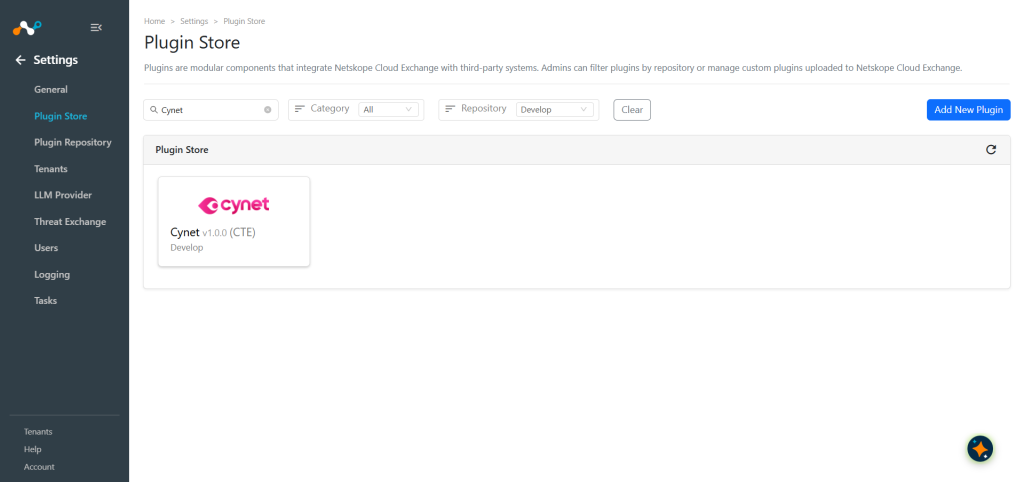
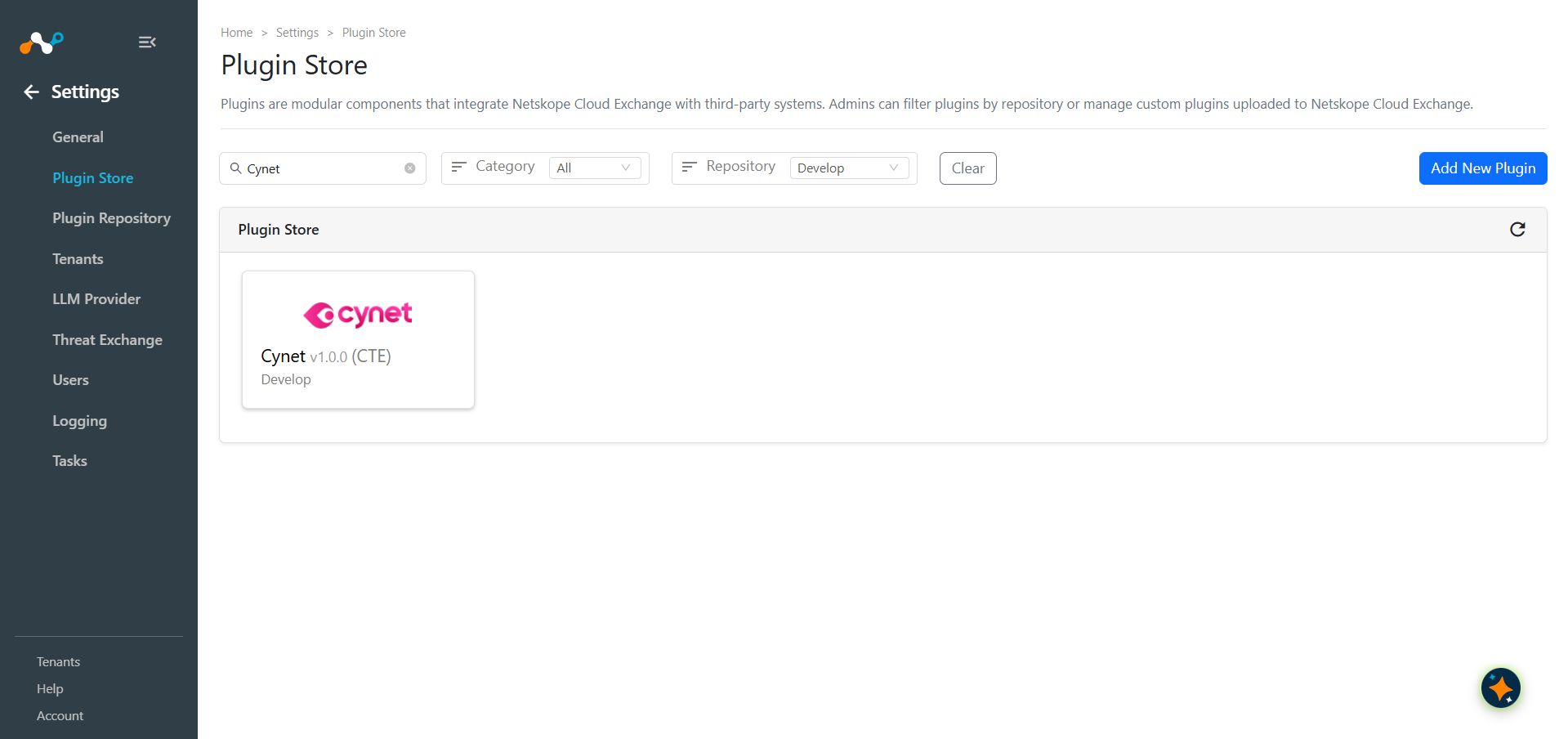
In Cloud Exchange, go to Settings > Plugin Store. Search for and select the Cynet v1.0.0 (CTE) plugin.
-
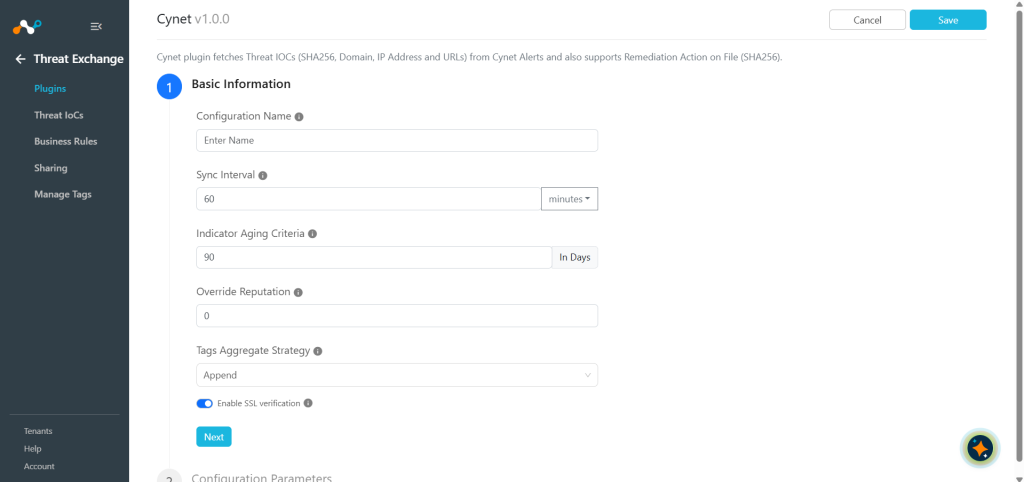
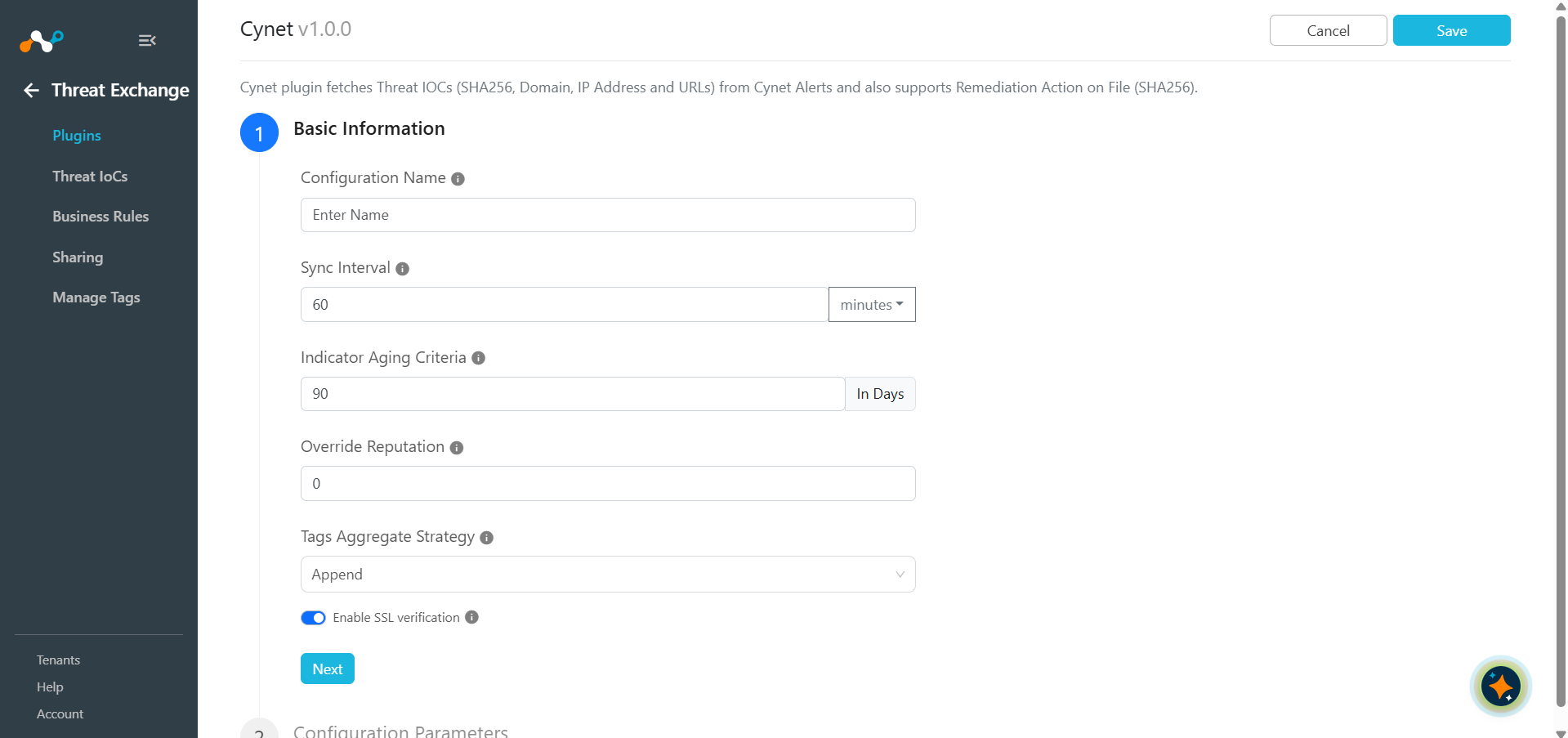
Enter the Basic Information:
- Configuration Name: Unique name for the configuration.
- Sync Interval: Leave the default.
- Aging Criteria: Expiry time of the plugin in days. (Default: 90)
- Override Reputation: Set a value to override the reputation of indicators received from this configuration.
- Enable SSL Validation: Enable for SSL Certificate validation.
- Use System Proxy: Enable if the proxy is required for communication.
-
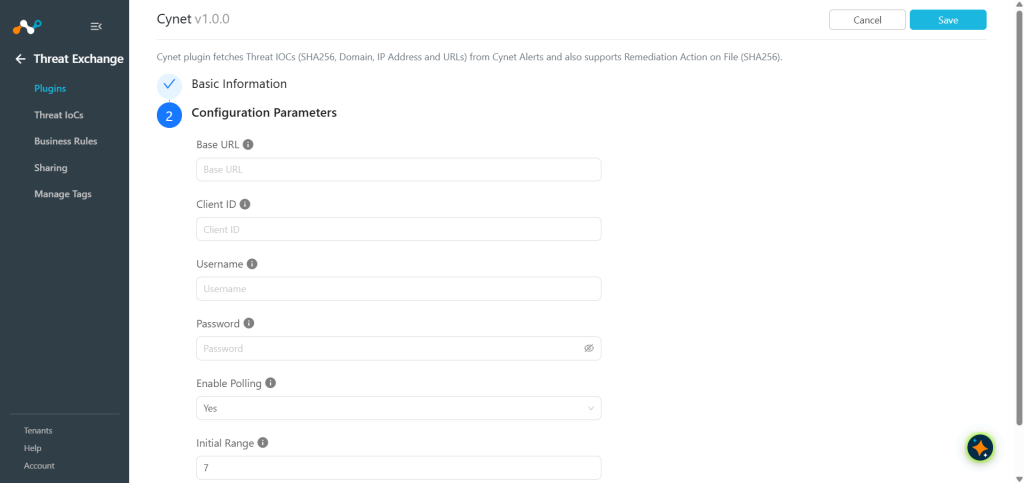
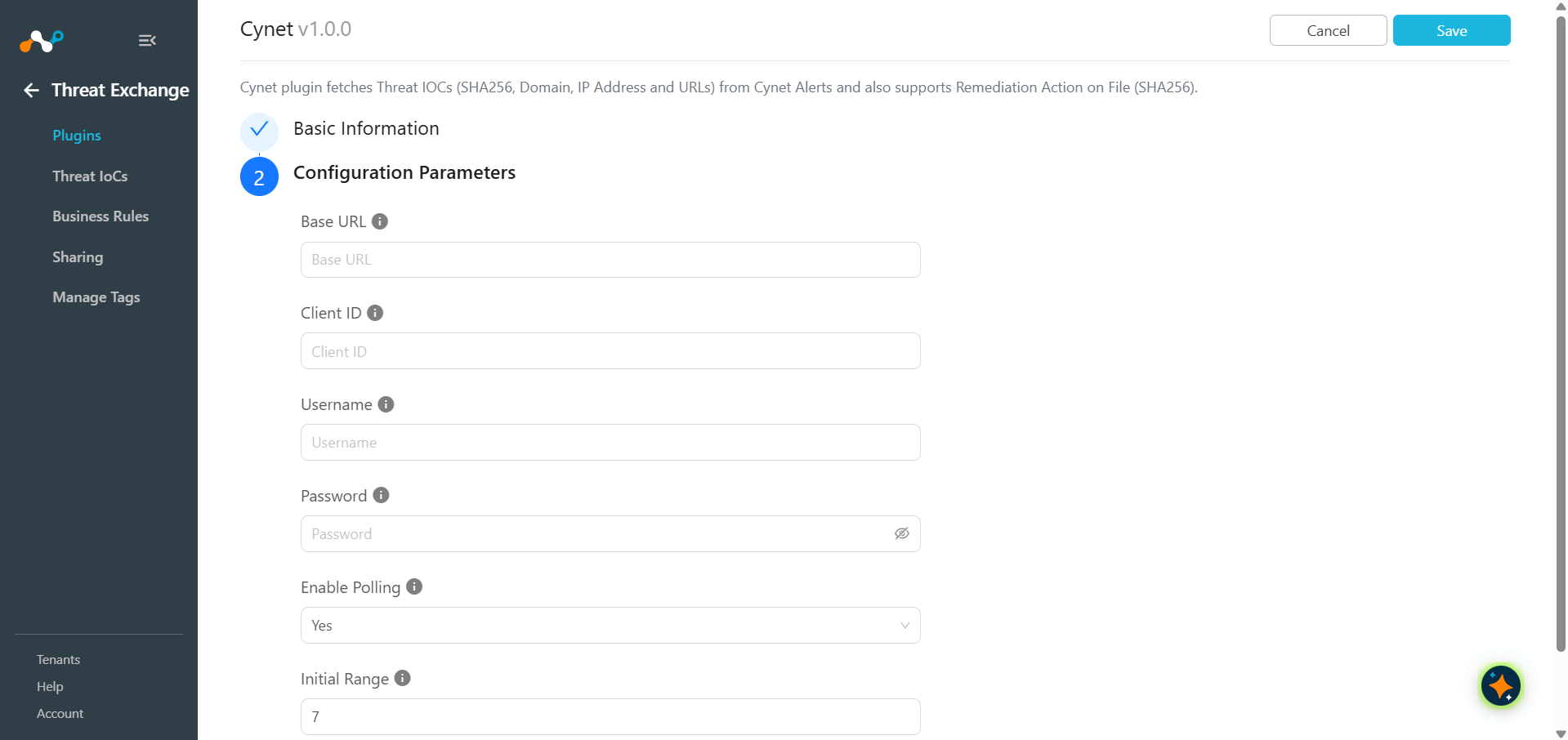
Click Next and enter the Configuration Parameters:
- Base URL: Base URL of Cynet instance (like https://local.api.cynet.com).
- Client ID: Client ID generated from the Cynet platform. The Client ID can be generated from the Global Settings > Client Site Manager > Sites Status page.
- Username: Cynet platform login username.
- Password: Cynet platform login password.
- Enable Polling: Enable/Disable polling Threat IoCs from Cynet. Disable if you only need to perform the Remediation Action.
- Initial Range: Number of days Threat IoCs to pull in the initial run.
-
Click Save.
Configure a Threat Exchange Business Rule for Cynet
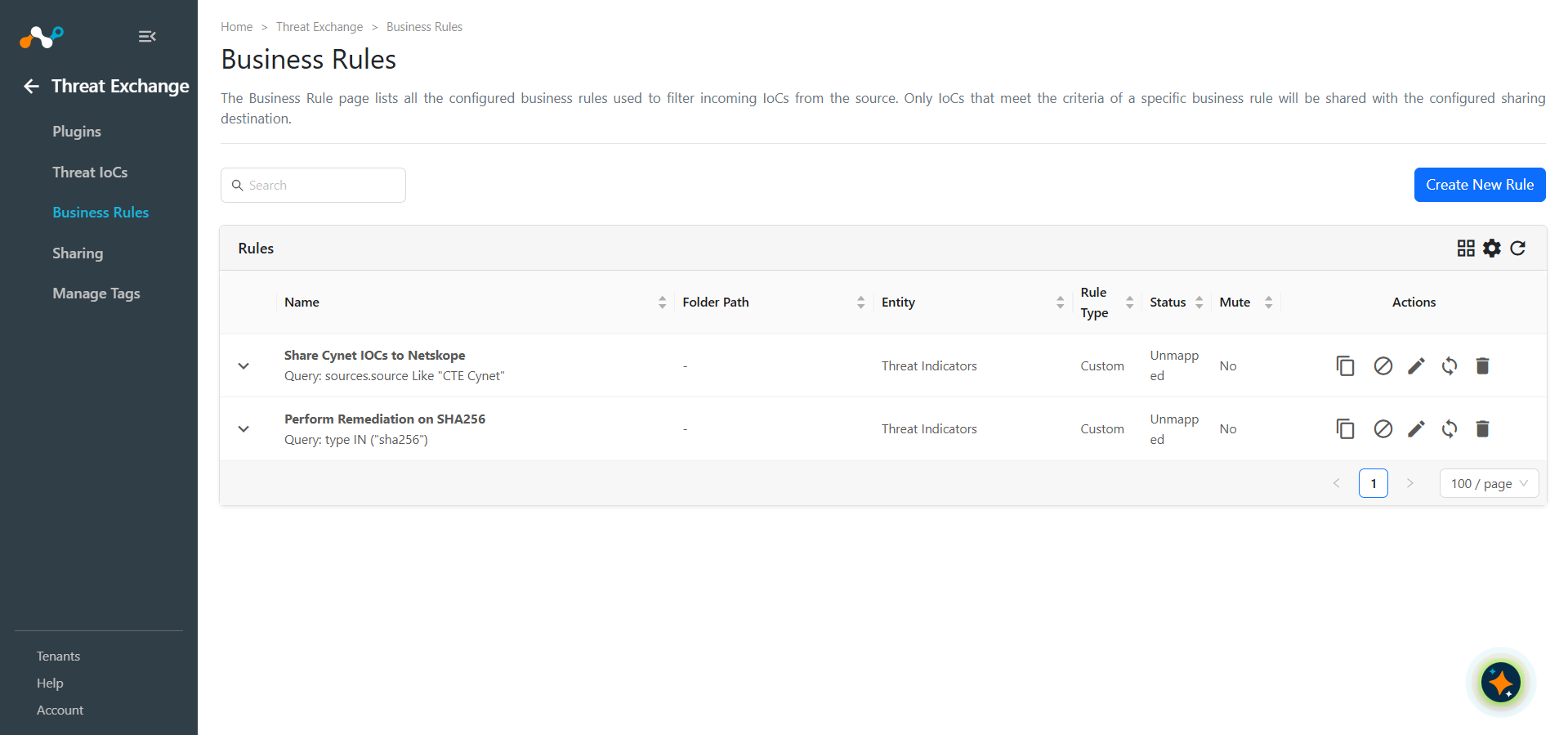
To share indicators fetched from the Cynet to the Netskope and vice versa you will need to have a business rule that will filter out the indicators that you want to share.
To configure a business rule:
- In Threat Exchange, go to Business Rules and click Create New Rule.
- Add the filter(s) according to your requirement in the rule. When finished, click Save.
Configure Threat Exchange Sharing
To share IoCs from Cloud Exchange to the Cynet platform, or vice-versa:
- In Threat Exchange, go to Sharing and click Add Sharing Configuration.
- Select your Source Configuration (Netskope CTE), Business Rule, Destination Configuration (CTE Cynet), and Target.
- Select the type of Remediation action from the dropdown list with values: Delete File, Kill Process, Quarantine, Unquarantine, Verify File.
- Click Save.