

Netskope LogoNetskope Logo
  • Security Services
  • AI Services
  • Networking Services
  • Analytics Services
  • Integrations
  • getting-started.svgGetting Started
    • Support
    • Community
    • Netskope.com
    © 2026 All Rights Reserved. Netskope Inc.
    Home
    AI Command Center
    AI Inventory

    AI Inventory

    The Inventory page provides a centralized view of AI assets discovered across your organization, giving you visibility into the enterprise AI ecosystem. You can explore and analyze AI assets such as AI Applications, MCP Servers, Agents and Models used by users across the enterprise. These assets might be accessed from managed endpoints, run locally on managed endpoints.

    The discovery of agents, models, and local MCP servers on managed endpoints is available as a beta feature. Beta features are provided as-is and may change before general availability. To request access, contact your Netskope account team.

    By consolidating this information into a single interface, the Inventory page helps you understand how AI components are interconnected, identify high-risk assets, and investigate user interactions and data flows. This page is primarily used for in-depth analysis, allowing you to drill down into specific entities for effective monitoring and governance.

    Use the time range filter in the top-right corner to select a time frame. All metrics and data on the page update dynamically based on the selected range. The same time range options are available as on the Overview page.

    Search and Filtering

    A search bar is available above each inventory table, allowing you to filter results by name or identifier. Each section also provides filter dropdowns specific to the data type. When filters are active, a “Clear All” button appears to reset all filters at once.

    The Inventory page UI is organized into two primary sections: Assets and Identities

    Assets

    Provides a detailed view of discovered AI applications, MCP servers, Agents and Models used across the enterprise, whether accessed from managed endpoints, running locally on endpoints, or hosted in cloud and on-premises environments.

    AI Applications

    The AI Applications provides visibility into AI applications used within the organization.

    • Category – Shows the top 10 application categories by usage. Click a category to filter the table.
    • Status – Shows the distribution of Sanctioned vs Unsanctioned applications. Click a segment to filter.
    • CCL – Shows the distribution of applications by Cloud Confidence Level. Click a bar to filter.

    The following table displays a list of AI applications discovered in your environment with the following details:

    • Name – Name of the AI application.
    • Category – Category of AI application for example, Conversation, Code, Writing, Platform, Meeting.
    • Status – Takes Sanctioned or Unsanctioned values depending on the AI Application status.
    • CCI Score – CCI score associated with the application.
    • #d Identities – Number of unique users interacting with the application for selected time range.
    • #d Bytes – Volume of data exchanged with the application (upload and download) for selected time range.
    • #d Sessions – Number of sessions involving the application for selected time range.
    • First Seen – Timestamp when the application was first detected in the environment.

    Click any row to open the application detail panel.

    MCP Servers

    The MCP Servers provides insights into MCP servers accessed by your organization steered by Netskope.

    • Category – Shows the top 10 MCP server categories by usage. Click a category to filter.
    • CCL – Shows the distribution of servers by Cloud Confidence Level. Click a bar to filter.

    The following table displays a list of MCP Servers discovered in your environment with the following details:

    • Name – Name of the MCP server.
    • Category – Category of the MCP server. For example, AI Infrastructure, Communication, Database.
    • CCL Score – Cloud Confidence Level associated with the server.
    • #d Identities – Number of unique users interacting with the MCP server over the selected time range.
    • #d Events – Number of events triggered on the server for selected time range.
    • #d Sessions – Number of sessions for the selected time range.
    • First Seen – Timestamp when the server was first detected.
    • Footprint – Number of managed endpoints where this MCP server was detected by NS Client. Hover over or click on the footprint number to see more details. Available when Endpoint AI Discovery is enabled. For details on what NS Client discovers on the endpoint, see Assets Detected during AI Discovery.

    Click any row to open the MCP server detail panel.

    Agents

    The Agents section provides visibility into AI agents discovered across your organization, such as browser extensions, editor extensions, and desktop extensions that use AI.

    • Category (top 10) – A treemap showing the top 10 agent categories by count (for example, Browser Extension, Editor Extension, Desktop Extension, Agents). Click a category to filter the table.
    • Framework (top 10) – A bar chart showing the top 10 frameworks. Click a framework to filter the table.

    The following table displays a list of agents discovered in your environment with the following details:

    • Name – Name of the AI agent, for example, IntelliCode, Amazon Q, Browser Copilot. A sublabel shows the agent type, for example, Editor extension or Browser extension.
    • Footprint – Number of managed endpoints where this agent was detected. Hover over or click the footprint number to see more details.
    • Category – Category of the agent, for example, Browser Extension, Editor Extension, Desktop Extension, Agents.
    • Framework – Framework associated with the agent. Displays Unknown when the framework cannot be determined.
    • #d Bytes – Volume of data exchanged by the agent for the selected time range.
    • #d Sessions – Number of sessions involving the agent for the selected time range.
    • #d Identities – Number of unique identities associated with the agent for the selected time range.
    • First Seen – Timestamp when the agent was first detected.
    • Last Seen – Timestamp of the most recent detection.

    Click any row to open the agent detail panel.

    Models

    The Models section provides visibility into AI models discovered on managed endpoints through the Netskope Client (NS Client) Endpoint AI Discovery feature. This section lists locally running AI models, such as open-source large language models (LLMs) running in frameworks like Ollama or vLLM, that are not transiting the network and would otherwise be invisible to network-based discovery.

    The following table displays a list of AI models discovered on managed endpoints with the following details:

    • Name – Name of the AI model as reported by NS Client. Where multiple endpoints report different names for the same underlying model, AICC deduplicates them into a single entry.
    • Category – Categories of the AI model, for example, Language Model, Code Model, Multimodal.
    • #d Endpoints – Number of managed endpoints where this model was detected during the selected time range.
    • #d Users – Number of unique users on whose devices this model was detected during the selected time range.
    • First Seen – Timestamp when the model was first detected on any managed endpoint.
    • Last Seen – Timestamp of the most recent detection of this model on any managed endpoint.

    Click any row to open the model detail panel.

    Identities

    This section offers visibility into users interacting with AI systems, helping you analyze user activity for specific identities.

    Users

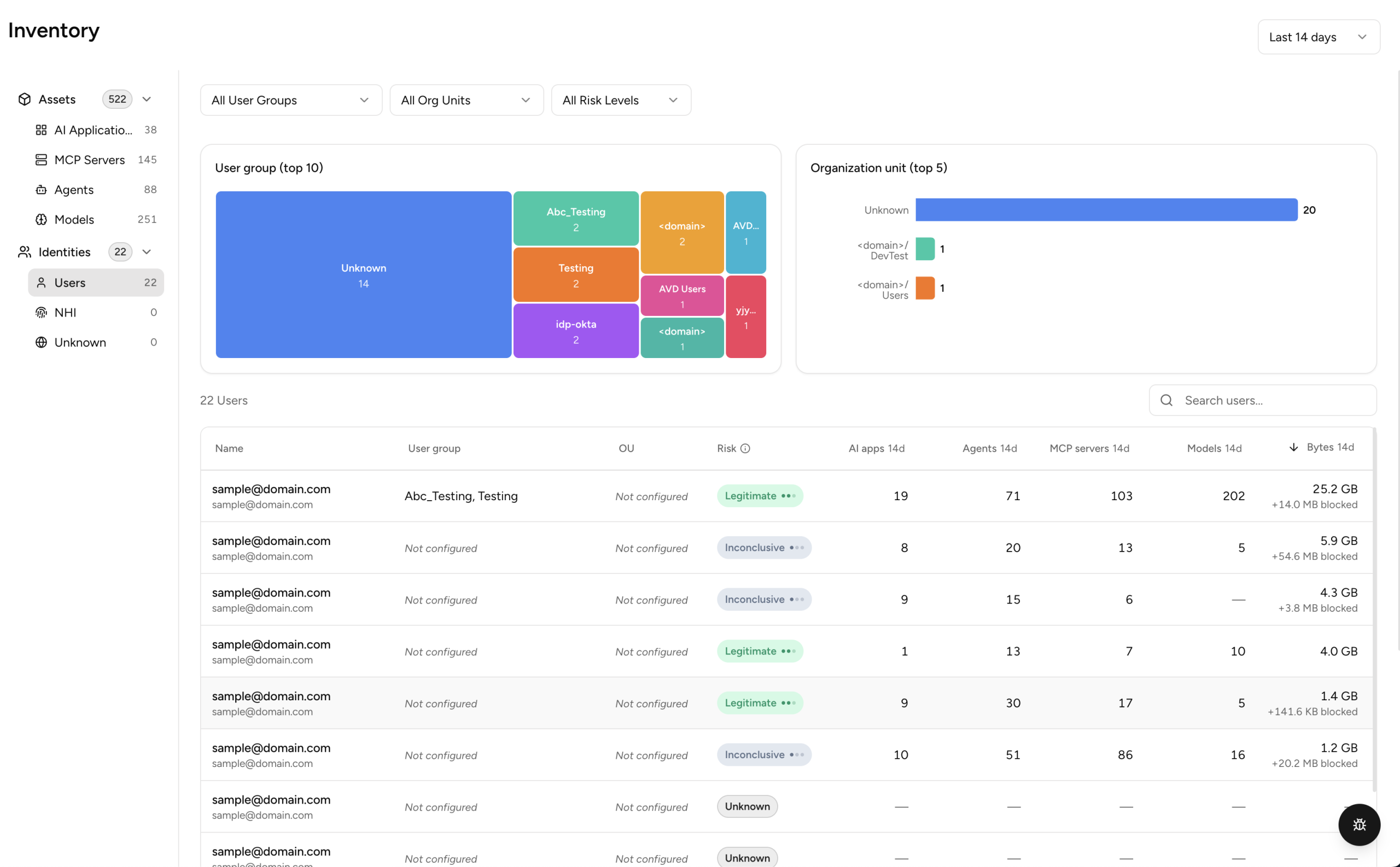
    The Users section, under Identities, provides detailed visibility into individual users interacting with AI applications and assets within your organization.

    • User Groups – Shows the top 10 user groups by usage. Click a group to filter.
    • Organization Unit – Shows the top 5 organizational units. Click a bar to filter.
    User Group and Organization Unit data are only populated when the tenant has Identity Provider (IdP) integration configured. Without IdP, these columns display “Not configured” with a tooltip explaining how to enable them.

    The following table displays a list of users in your environment with the following details:

    • Name – Name or identifier of the user.
    • User Group – Group assigned to the user.
    • OU – Organizational unit or department.
    • #d Apps – Number of AI applications accessed by the user in selected time range.
    • #d MCP Servers – Number of MCP servers (discovered on NG-SWG and on managed endpoints) the user has interacted with in the selected time range.
    • #d Bytes – Volume of data exchanged by the user across AI services in selected time range.
    • #d Sessions – Number of sessions initiated by the user involving AI applications in selected time range.
    • First Seen – Timestamp when the user was first detected interacting with AI services.
    • #d Models – Number of distinct AI models detected on this user’s managed endpoint(s) during the selected time range. Populated when Endpoint AI Discovery is enabled.

    Click any row to open the user detail panel.
    Unknown

    The Unknown section, under Identities, provides visibility into interactions with AI applications and assets where the user identity could not be determined. These entries typically represent activity from unmanaged, unauthenticated, or unrecognized sources, and may indicate potential gaps in identity visibility or control.

    The table displays a list of unidentified entities interacting with AI services with the following details:

    • Source IP – IP address of the unknown entity (primary identifier).
    • Hostname – Hostname associated with the entity, if available.
    • #d Apps – Number of AI applications accessed in selected time range.
    • #d MCP Servers – Number of MCP servers interacted with in selected time range.
    • #d Bytes – Volume of data exchanged with AI services in selected time range.
    • First Seen – Timestamp indicating when the activity was first detected.
    • Last Seen – Timestamp of the most recent activity.

    Click any row to open the unknown identity detail panel.

    In this Topic
    • AI Inventory